Phnom Penh Fire Damage and Relief. March 2010.
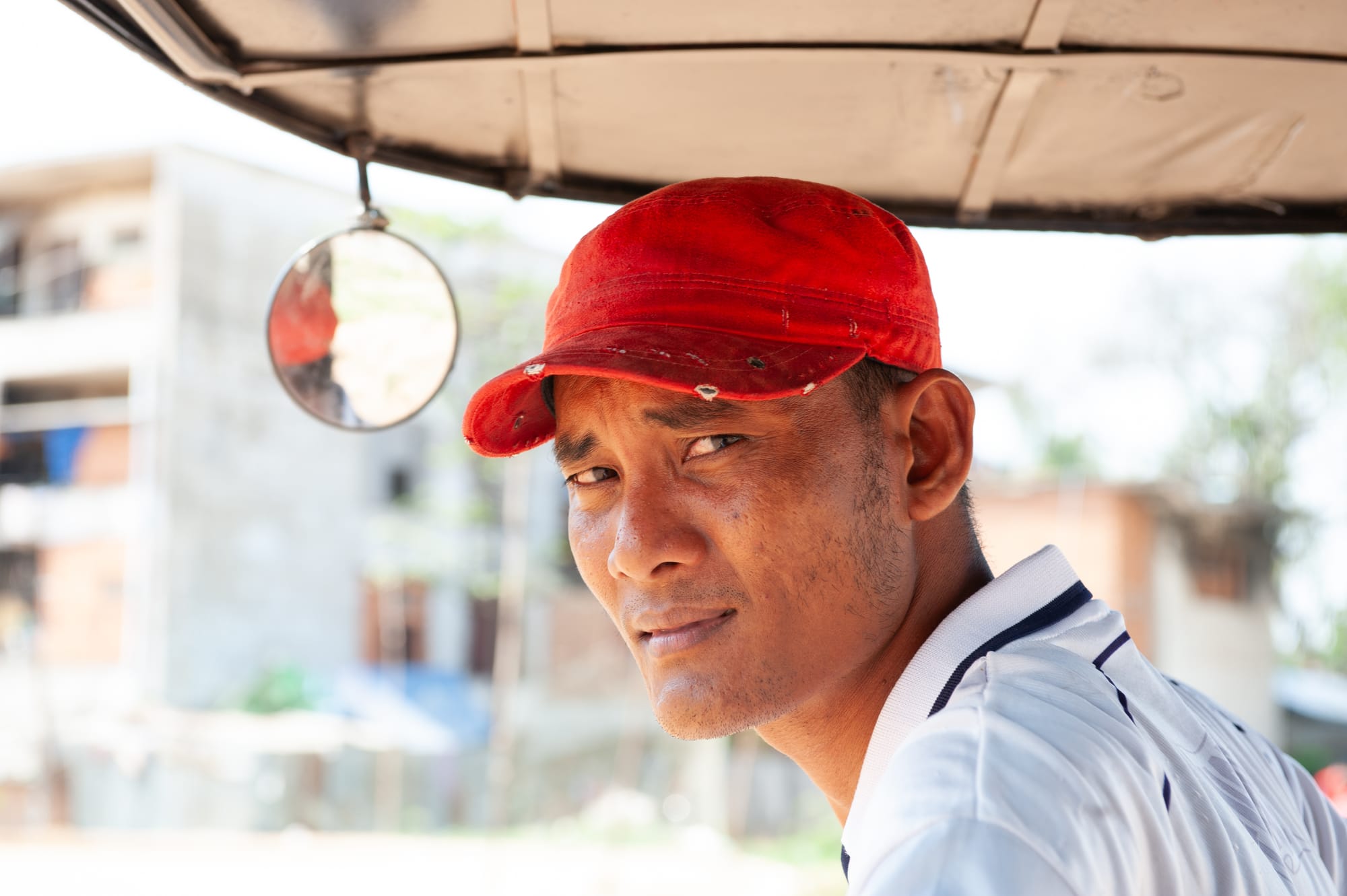
As I transited the airport, having jumped off the short hop from Bangkok, through the Phnom Penh immigration, I thought I'd need to cross the car parking areas then onto the main road to find my trusted tuk-tuk driver and assistant in the city.
And there he was, as always, a sharp boy, really, a little bit of who you would describe as a cheeky chappie, but what an ideal person for taking me around, to visit places I wished to visit, to safely see areas I wished to view. I'd used him before, a few times, and I continued to employ him as my driver when I was in Phnom Penh for the next two years or so.
If I was a working photojournalist, which I was not, I would probably have called him my fixer, a sobriquet which would have described particularly well the role he actually performed dutifully for me. My driver, my ‘fixer’.
It's March in 2010, and as I jumped into his tuk-tuk with my camera bag and my little rucksack porting a few clothes for a week or so, he welcomed me, greeted me, hugged me and then said, "Stephen, I think we've got some good photographs for you to take tomorrow morning," of which, naturally, I wanted to get to know more. I was really back in PP to write and photograph more about the Davy Keo story.
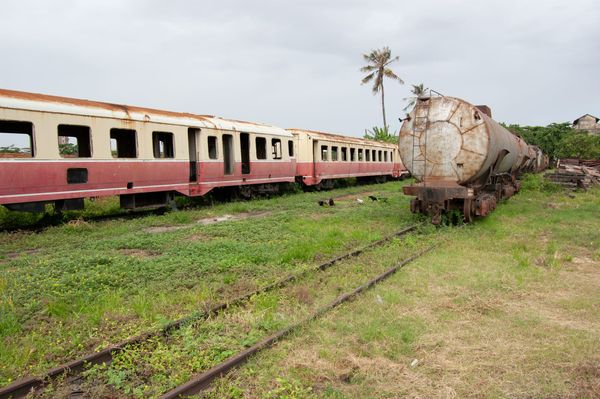
He explained to me that a few days earlier there had been a huge fire. Actually, in central Phnom Penh, in one of the poorer settlements, very close to the train line that was by then a disused iron road.
"We'll go tomorrow."
I wanted to go that evening; it was still only about 4:30, but he suggested that it would be much better to go on the following day.
So, to my hotel, for a little relaxation. I bought him a meal, as I always did, perhaps a couple of beers, and then the next morning he picked me up nice and early, as he always did.
He drove me for my breakfast, along... I can't remember the café, but a wonderful little café that I'd visit every day, sit outside, look onto the river, the Tonle Sap. Is it? Yes, the Tonle Sap, where it joins the Mekong, and eat my breakfast of eggs and bread in that peaceful ambiance, looking forward to the day ahead.
Off we went. I think it was only about a ten minutes' drive. Away to visit this site of the fire that had devastated this smallish community, maybe a few acres of land in total which had been destroyed.
He was always very good at gaining access for me, walking with me - escorting me - talking to the locals, informing me. They were all looking at me as we entered the commune, nervously wondering why I was there.
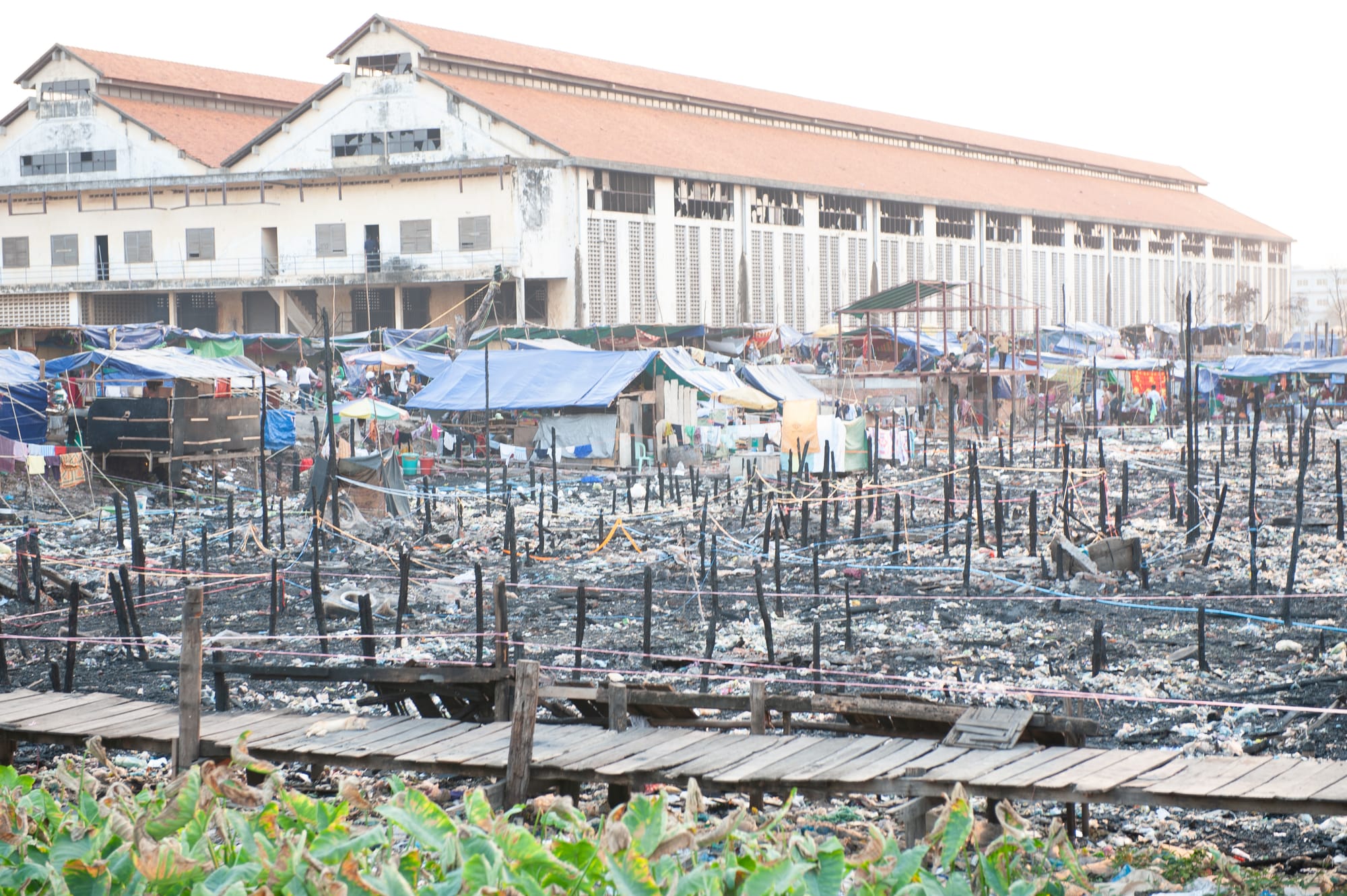
I guess he explained that I was there looking at the damaged remains of their village, an estate of traditional houses supported on stilts, all with wooden floorboards and wooden side walls and, probably cardboard boxes too, all around insulating lining for each home.
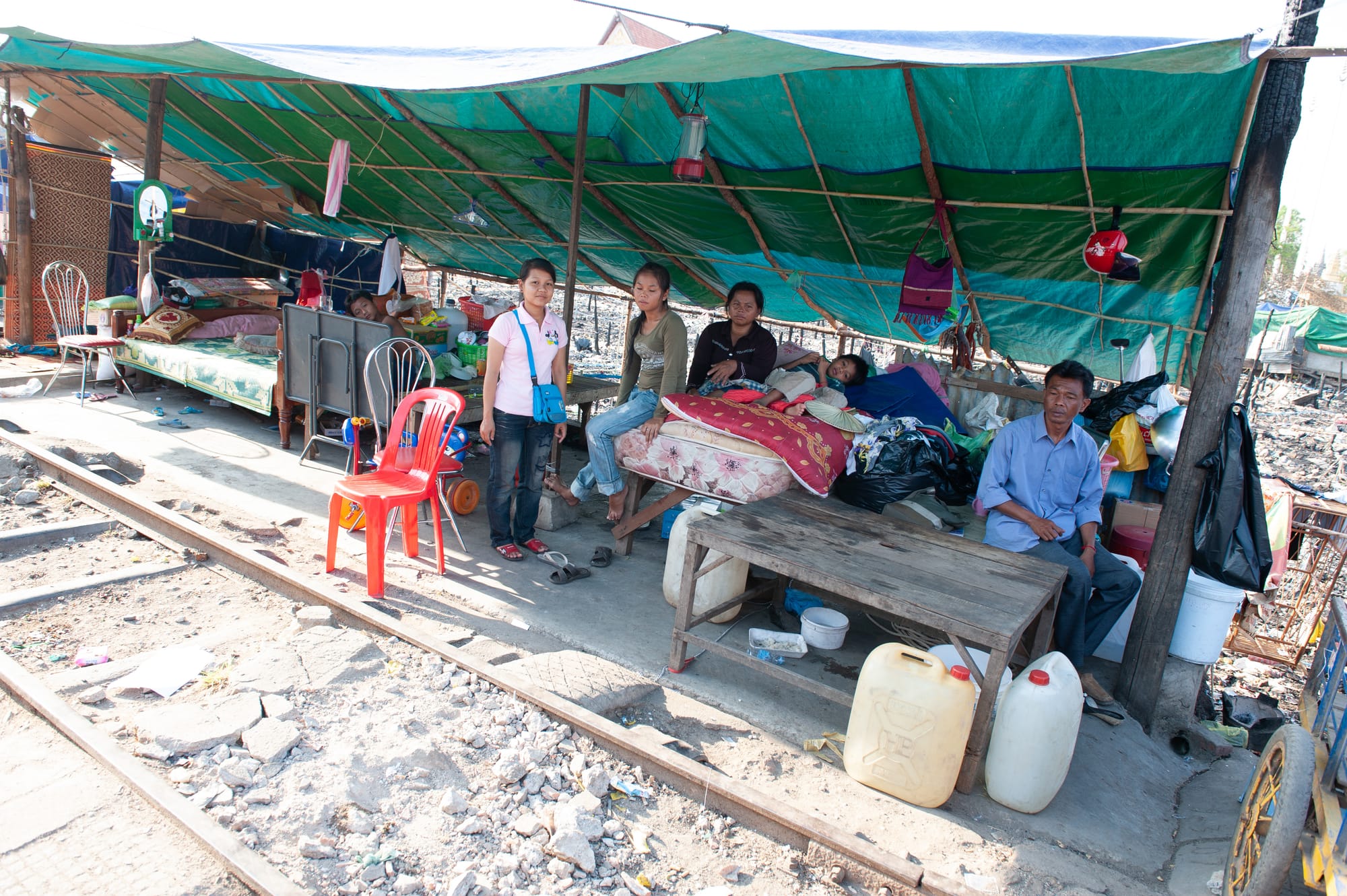
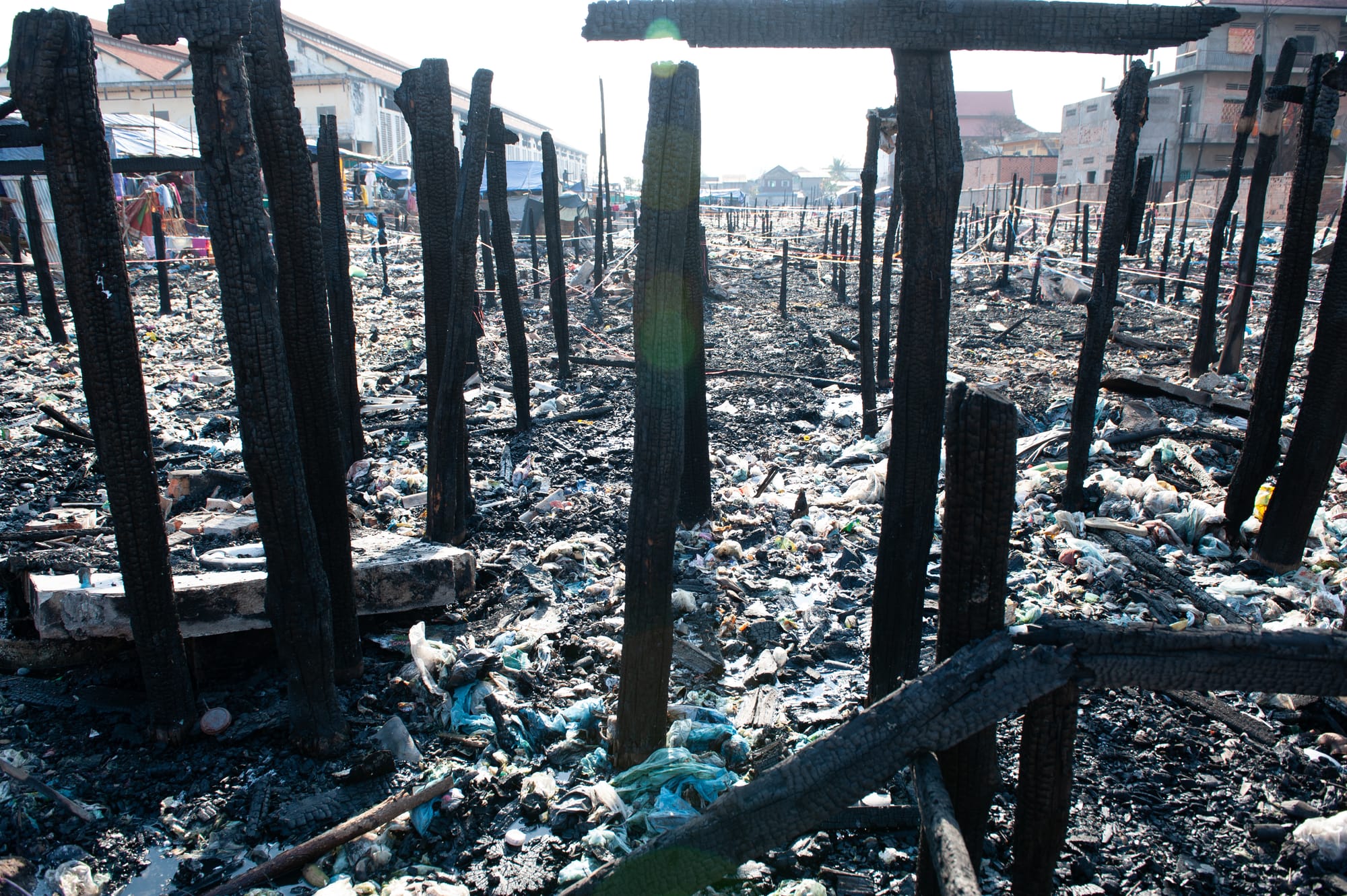
Presumably, the fire started in one of these precariously constructed houses, then spread rapidly through all the area. All I saw was a scorched earth, with stumps, charred wooden shards protruding from the litter, the debris of life, the damp underside where the fire had deposited its ashes and unburnt clinker. The vista spurred memories of a childhood spent cleaning out my grandma’s fire grate ashes in the stillness of the morning, following an evening watching the dancing flames and sparking coal burning away in her polished hearth.
What an absolute mess, as my mother would have said.
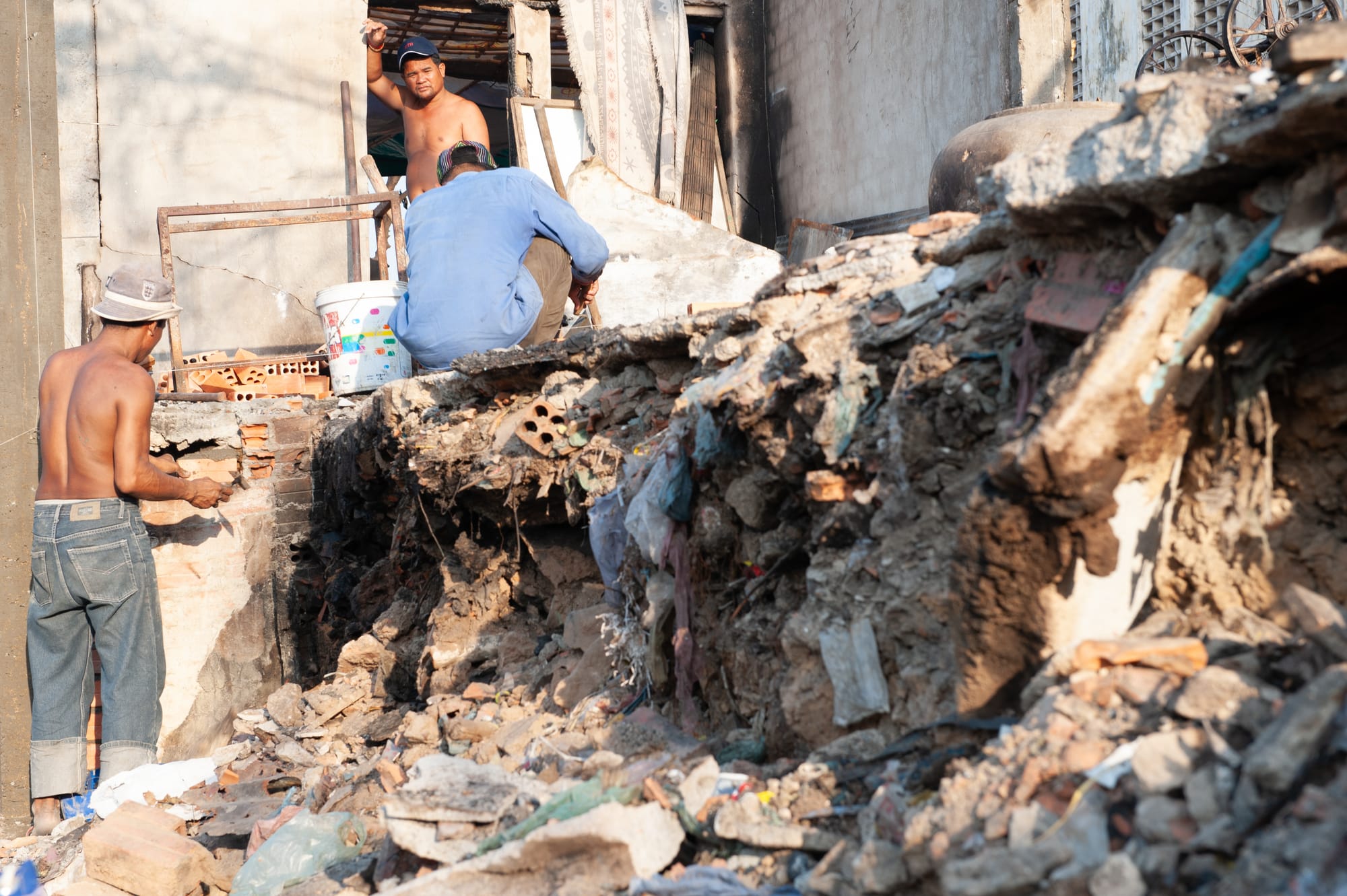
As we walked around, some people were starting to claim their patch, to peg-out their plot of land. A few men were starting to build, a few bricks and mortar, foundations for their future hopes to be built upon. I’m guessing that they wanted to ensure that no one else took away their plot, their land, their housing areas.
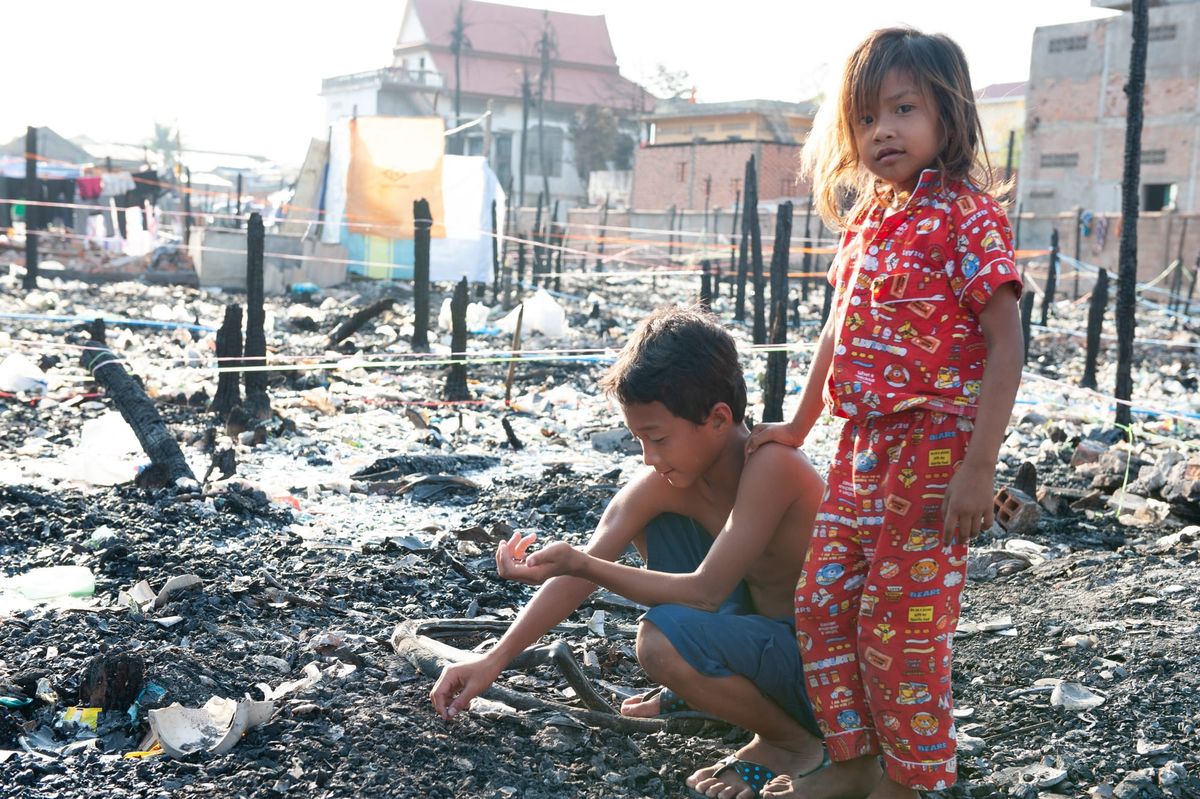
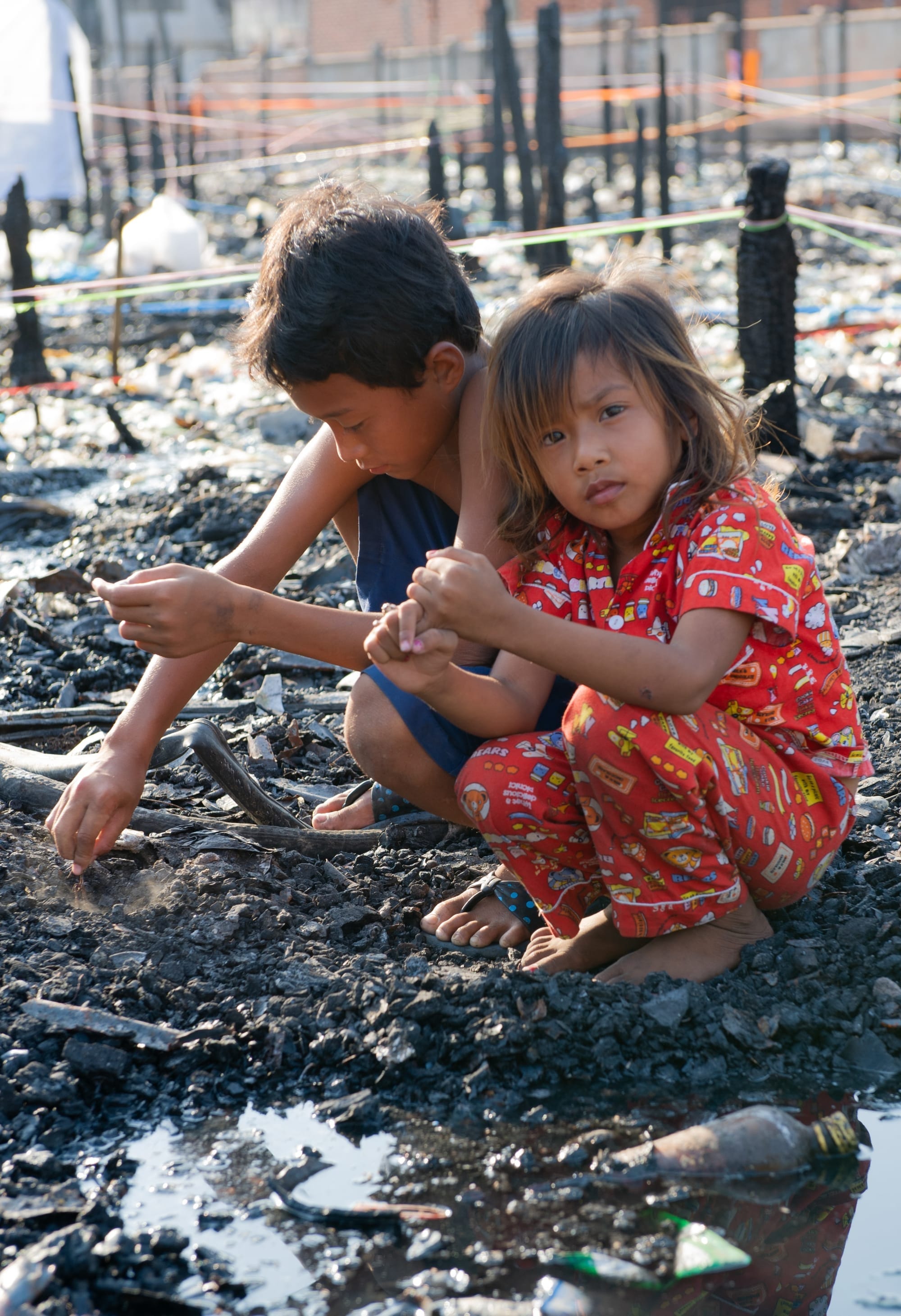
Kids sat on barren platforms, wondering what had happened, I suspect, as children generally do. There were still some houses and living spaces around the edge of the disaster, but generally the homes were lost as I gazed across the sea of blackened poles, past hundreds of charred stumps protruding from the stinking, sodden, detritus-screened earth.
That was how it showed itself to me, and, still there were young kids still playing in the graveyard.
I did try to find out where the fire had started, or why it couldn't have been extinguished; why there were apparently no fire engines available. This was Cambodia in 2010. People, tourists, used to call it a pretty wild and raw city, even back then in the first decade of the 2000s. I guess, and that’s all it is a guess, that municipal fire engines, the volunteer collective firefighting teams found access into that area impossible, even if they tried.
Almost an entire settlement had vanished in what must have been, on that evening, a few days previously, a nightmarish fog of superheated orange smoke. Gone. Disappeared. Now a vacuum having displaced all dwellers swiftly from the area.
There was a distinguished building quite close to the aftermath of the fire; my driver suggested that, "we should walk down the road towards the temple as today the local monks plus honoured dignitaries are giving aid, offering material assistance to those people that have lost their homes." My words in memory, not his verbatim.
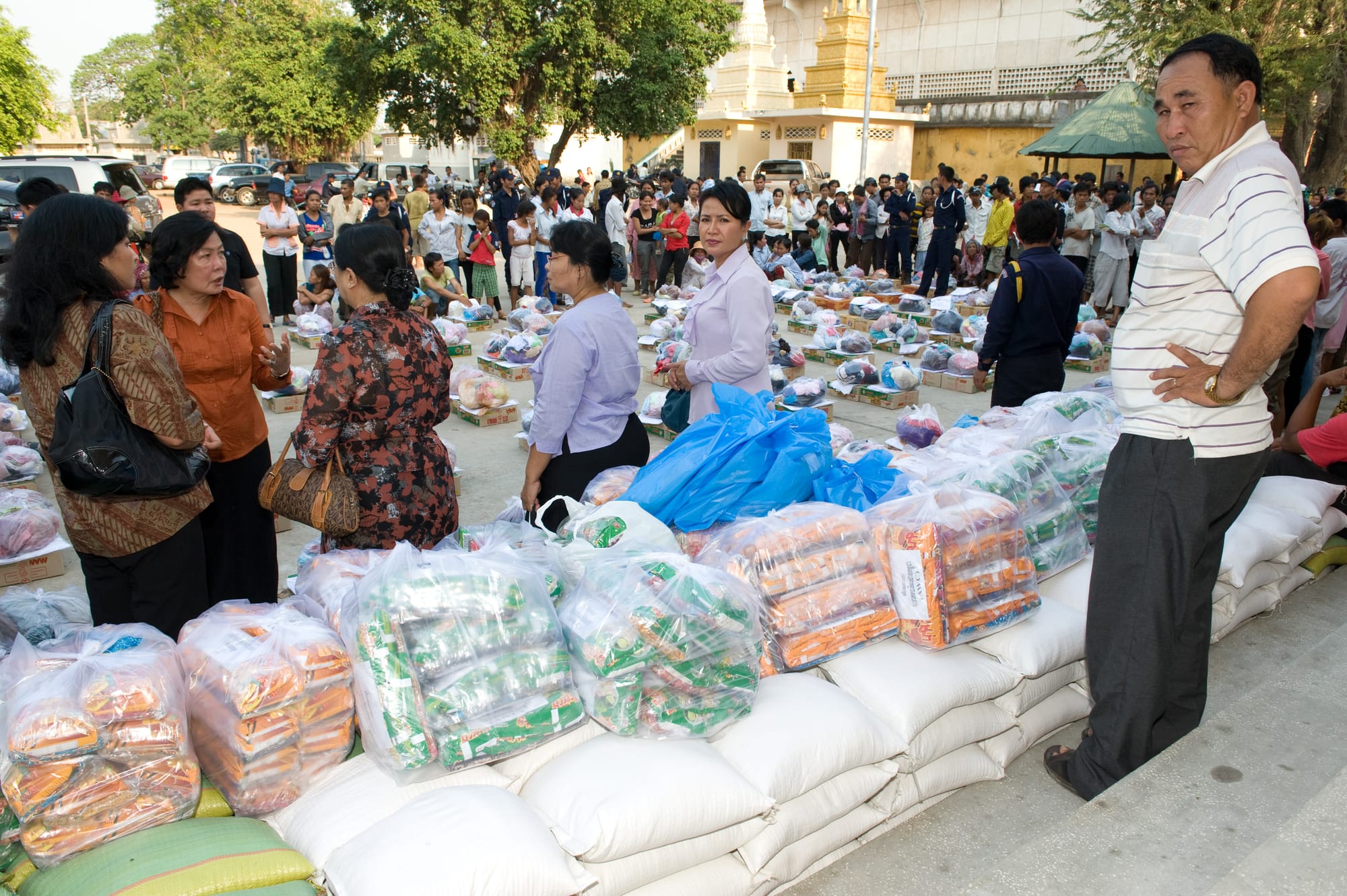
Relief supplies assembled for distribution to families affected by the settlement fire. Phnom Penh, March 2010.
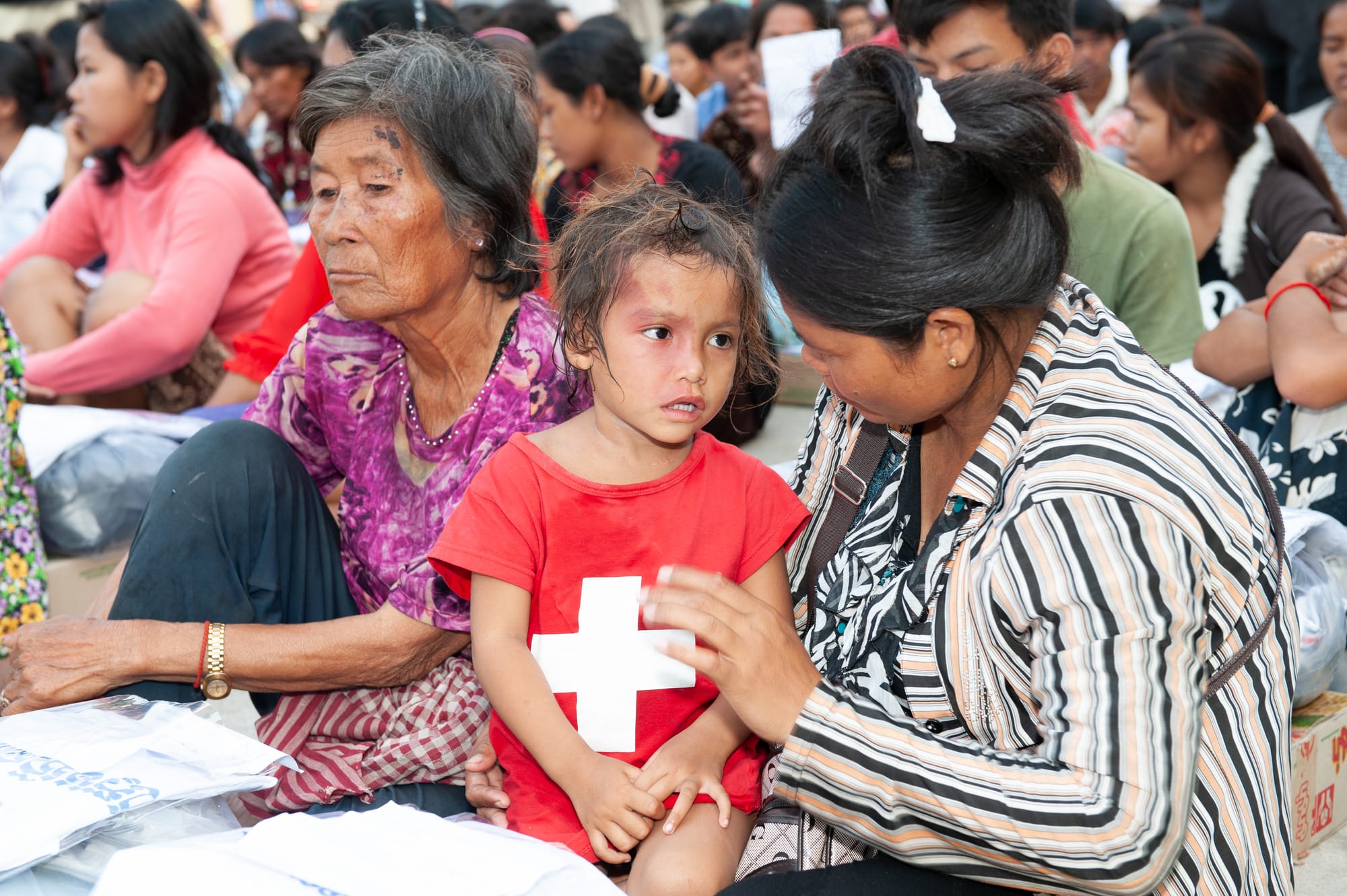
We walked. Past lots of sad-looking people, youngsters walking alongside parents, pensive old women, all heading towards a temple. Then inside: a worshipful gathering, many men and women, chanting monks. Outside: all waiting for aid, parcels of charity collected, gathered and distributed by a seemingly well-to-do group of individuals – from their dress together with the watches they wore and the shoes they bore that was the appearance they gave. Charitable people, somewhat nervous in front of the lens, who felt they needed to support the aid effort, help for these poor people, support for families who'd lost their homes and, presumably, lost most of their belongings too, in that furnace a few days previously.
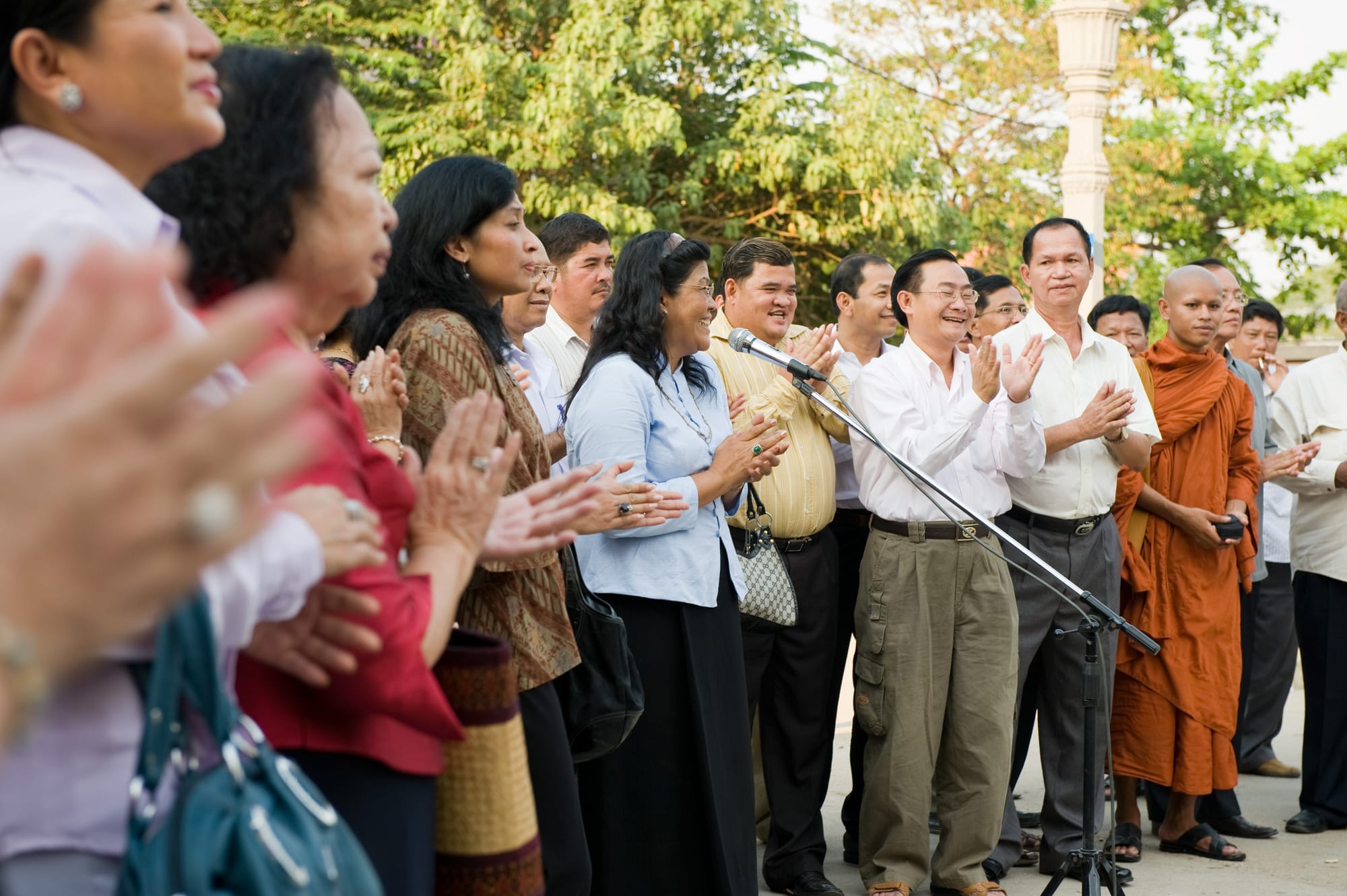
That's it all really. I don't know where these people went to live. I’m not sure if any died or were injured in the blaze. All I observed and sensed was simply, a sad depressed atmosphere clinging menacingly around the land where their houses had been densely packed together, and also hanging above the crowd as they patiently waited for the bags of rice, the T-shirts, and whatever they were being offered to reboot their lives. A sixth sense maybe, but I felt it as authentically real.
I returned later that afternoon to visit other inhabited dwellings adjacent to, and surrounding the scorched remains of the community. The disused train lines with their shanty shacks seemed to act as the bounding break of a firepit on a campsite.
And palpably to me, the atmosphere posed that unspoken question across the whole community: why has this happened to us? Again.
(c) Stephen Ford 2026.